
Benign Neglect or Active Destruction?
In a four-part series, we summarize academic articles published by the Scalabrini Institute for Human Mobility in Africa (SIHMA), which conducts research on migration in Africa. The article summarized below, “Benign Neglect or Active Destruction? A Critical Analysis of Refugee and Informal Sector Policy and Practice in South Africa,” was originally authored by Jonathan Crush, Caroline Skinner, and Manal Stulgaitis.
In 2007, the Zimbabwean economy crashed, causing great numbers of Zimbabweans to come to South Africa in search of work and stability(1). The massive influx of migrants put the South African asylum system under significant pressure, shedding light on crippling weaknesses in the system. Unfortunately, the asylum has increasingly been conflated with generalized migration. Officials across the country adopted the position that 90% of asylum seekers are economic migrants and denounced them as abusers of the asylum system.(2)
Looking at the big picture, the underlying problem is not the arrival of migrants and asylum seekers, but the fact that the South African asylum system is overwhelmed, corrupt, poorly-informed, and mismanaged. Delays in status adjudication, arbitrary status decisions, and the tendency to decide claims based on a migrant’s home country rather than individual experiences are all commonplace. Moreover, widespread xenophobic attitudes portray migration as a zero-sum game in which any advantages for migrants come at the cost of South Africans and which fail to acknowledge the positive economic, cultural, and social contributions that migrants and asylum seekers make.
In their recent survey “Benign Neglect or Active Destruction? A Critical Analysis of Refugee and Informal Sector Policy and Practice in South Africa,” Jonathan Crush, Caroline Skinner, and Manal Stulgaitis discuss these features of the asylum and migration landscape, connecting them to an overarching trend of rising restrictionism in asylum practice. They find that the post-apartheid refugee protection regime has shifted from a strongly rights-based approach to an approach rooted in restrictionism, exclusion, and general incompetence among status determination officials and others who implement refugee policy. Moreover, since the 1990s, the livelihoods of the many migrants and refugees who work in the informal sector – running shops and micro-businesses, street vending, etc. – have been threatened by sporadic governance. At best, municipal authorities across the country have neglected the informal sector in their policies, but at worst, they have actively sought to eradicate informal business. All of these trends and developments point to the necessity of rights-based refugee systems and more progressive, supportive informal sector policies.
From Rights-Based Protection to Rights Restriction
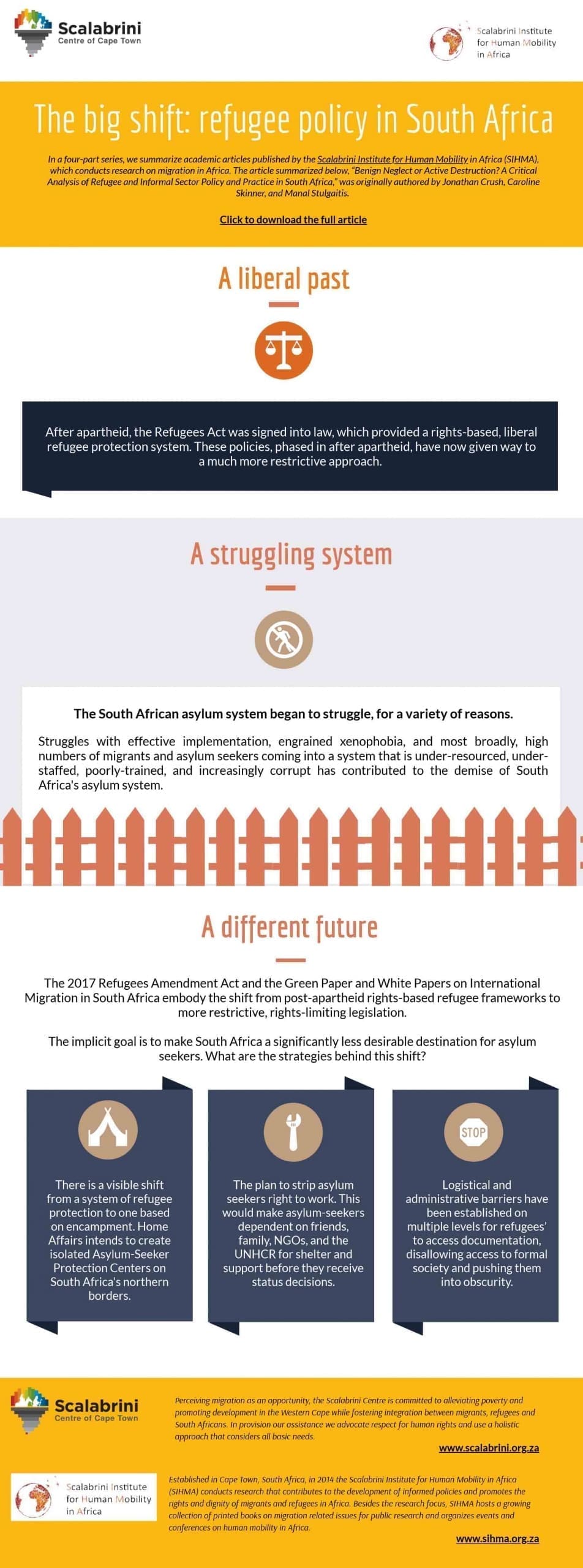
Drawing inputs from a variety of sources and 30 in-depth interviews with informants in Cape Town, Limpopo, and Gauteng, the authors identify the 2017 Refugees Amendment Act and the Green Paper and White Papers on International Migration in South Africa as embodiments of the shift from post-apartheid rights-based refugee frameworks to more restrictive, rights-limiting legislation. Over time, the rights-based policy reflected in the 1998 Refugees Act has eroded due to a combination of factors: struggles with effective and efficient implementation, the migration pressure brought by Zimbabwe’s 2007 economic collapse, engrained xenophobia among the public and policy makers, and most broadly, high numbers of migrants and asylum seekers coming into a system that is under-resourced, under-staffed, poorly-trained, and increasingly corrupt.
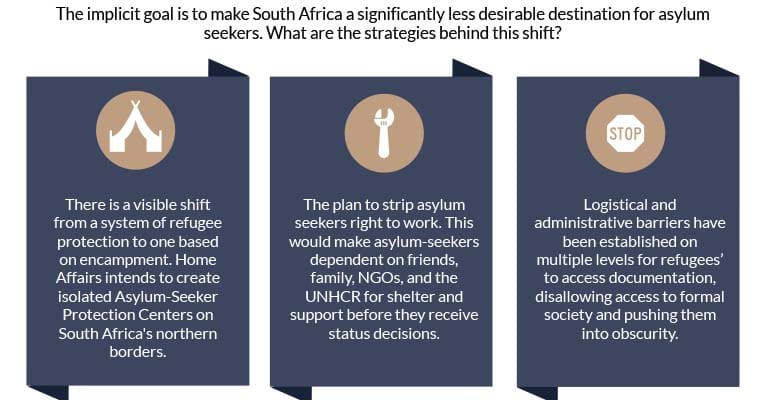
Four connected strategies are embedded in the 2016 Refugees Amendment Act, Green and White Papers, and other migration policy instruments, aiming to restrict rights, opportunities, and livelihood stability for refugees. The implicit goal is to make South Africa a significantly less desirable destination for asylum seekers.
First, there continues to be a visible shift from the earlier refugee protection paradigm of integration to one based on encampment. The DHA (Department of Home Affairs) intends to create isolated Asylum-Seeker Protection Centers that would essentially serve as detention centers where asylum seekers live until the conclusion of their status determination processes; this system would bar asylum seekers’ abilities to integrate, find work, study, or move through the country freely, and it would render them dependent on the UNHCR or government for basic needs.
Second, logistical and administrative barriers have been established on multiple levels to undermine refugees’ stability. The number of Refugee Reception Offices (RROs) was cut in half by the DHA, and the current requirement that asylum-seekers renew their permits every one to six months at an RRO rather than at Home Affairs offices places significant financial and logistical hardships on the asylum-seekers. Moreover, the 2016 Refugees Amendment Act holds that a refugee or asylum seeker who fails to renew her permit within a month of its expiration will automatically have her status revoked, forfeit her right to future permit renewal, and be vulnerable to detention and arrest as an illegal foreigner. Under the act, a refugee can also only apply for permanent residence after ten years instead of the previous five. (3)
Third, recent policies and legislation have sought to undermine court judgements that have affirmed refugees’ and asylum-seekers’ rights to self-employment and other work. One aim of the 2016 Refugees Amendment Act is to overturn a judgement that affirmed asylum-seekers’ right to work while their refugee claims are adjudicated; this would make asylum-seekers dependent on friends, family, NGOs, and the UNHCR for shelter and support before they receive status decisions, disabling them from self-support for what can be a very long time.
Fourth, actions have been taken to limits asylum-seeker and refugees’ access to crucial financial services. Some banks refuse to open accounts for refugees and asylum-seekers, demonstrating low trust in Home Affairs documentation and only sanctioning accounts for individuals with South African national identity cards. Refugees who have managed to open accounts have repeatedly seen their accounts frozen due to changes in documents or the DHA failing to respond to verification enquiries, threatening the account holders’ abilities to afford rent, food, and travel to renew their status documents. Consequently, many refugees have to keep large stashes of cash in their homes and businesses, and especially in informal settlements and townships, these places are targeted by thieves and burglars.
Neglect and Targeting of the Informal Sector
Informal sector policies directly impact refugee livelihoods, as the lack of job opportunities in the formal sector largely restricts refugees to work in the informal sector. Surveying policies and actions from different levels of government, it becomes clear that South African treatment of the informal sector and migrants within it has been highly irregular, varying between neglect and marginalization to intentional destruction and oppression.
The apartheid government had a long history of opposing informal sector activity before the 1991 Business Act 71 started a reversal of the limiting apartheid policies. This more welcoming attitude toward informal business was again reflected in the 1995 White Paper on the Development and Promotion of Small Businesses and the 1996 National Small Business Act, which entitled survivalist businesses and micro-enterprises to government support and recognition in theory. Nevertheless, both pieces of legislation fail to acknowledge the specific concerns of migrants or refugees and generally overlook informal business. Moreover, the Department of Trade and Industry (DTI) has worked to build a nation-wide network of Local Business Development Centers to support enterprises of different size, but informal sector businesses still mostly fall through the cracks between unemployment and small business.
In 2003, President Mbeki gave the informal sector its first clear political recognition since the end of apartheid when he outlined the characteristics and potential of the so-called “second economy” – an economy that includes the impoverished rural and urban communities that make up much of the South African population, contributes minimally to the GDP, and generally struggles to drive its own growth or connect to the national “first economy.” Mbeki proposed a variety of measures to invest capital and resources into the second economy to help it integrate into the developed first sector.
However, since 2012, the informal sector has received national attention in a very sporadic, often disabling way. On the more benign side, The National Development Plan aims to create millions of jobs by 2030, including as many as 2.1 million informal sector jobs, but it includes no clear strategy for how this will be accomplished or how to knock down barriers that limit informal sector growth. DTI has been much more contradictory in its informal sector policies. In 2012, it established a directorate to support informal business development; the very next year, it released a Draft Business Licensing Bill that has been criticized for criminalizing the informal sector.
Some policies and practices go further, discriminating against migrants in the informal sector. In 2014, DTI’s National Informal Business Upliftment Strategy has signs of anti-migrant sentiment, referencing migrant takeover of local businesses. Though supposed to constructively regulate and support the informal sector, province governments have significant freedom in continuing to target migrant informal businesses. Limpopo Province launched a military-style crackdown called Operation Hardstick in 2012, in which police targeted migrant-run informal businesses, shut down over 600 businesses, detained shipowners, and told some business owners who were also refugees and asylum-seekers that their permits did not entitle them to running a business. Local governments have shown a pattern of targeting street vendors who are also migrants; in 2013, the Johannesburg City Council removed 6000 street traders, many of whom were migrants and asylum-seekers. The Cape Town government, meanwhile systematically excludes the contributions and development of street trade and township trade, and Somali-owned spaza shops in particular have been prohibited in some areas.
Conclusion
To conclude, Crush, Skinner, and Stulgaitis’s coupled analysis of refugee protection policy and treatment of the informal sector reveals that migrants and asylum-seekers must operate in an environment that limits their integration and stability at virtually every turn. The rights-based, more liberal refugee protection policies phased in after apartheid have given way to a much more restrictive approach. Not only does the DHA aim to severely limit asylum-seekers’ integration and mobility by phasing in an encampment strategy, but asylum-seekers and migrants also face numerous legal and administrative barriers in building stable lives in South Africa, are targeted by efforts to undermine court judgements that have affirmed their rights, and suffer from practices that stifle their access to banking and other financial services.
To compound all of these challenges, the government acts on a spectrum that runs from neglect to outright destruction of the informal sector businesses that provide so many refugees with incomes and livelihoods. In such a disabling and contradictory environment, migrants are pressured to be extremely self-reliant by the harsh protection policies, yet their self-reliance is constantly undermined by destructive or irregular informal sector policies. Litigation and the work of non-governmental organizations has helped to underline the contradiction between the generous rights listed in the South African Constitution and Refugees Act and the oppressive, marginalizing actions of government departments implementing and writing policy. However, the greater hope is that legislation and policy implementation that encourage migrants’ integration, rights, and economic contributions will come to replace the recent coercive approach.
This summarised article was written by a Scalabrini Centre of Cape Town Volunteer Lucy Arnold
CLICK ON THE IMAGE TO DOWNLOAD PDF
References
(1) Crush, J. and Tevera, D. (Eds.). 2010. Zimbabwe’s Exodus: Crisis, Migration, Survival. Ottawa: IDRC and Cape Town: SAMP.
(2) DHA. 2016. Green Paper on International Migration in South Africa. Pretoria: Department of Home Affairs.
(3) The 2013 Angolan Cessation is another key example of policy actions undermining refugee status. Rolled out by the DHA, this policy stripped Angolan refugees of their status regardless of how long they had lived in South Africa, issuing them two-year non-renewable temporary residence permits to allow them to set their affairs before their mandatory return to Angola. This action has been challenged successfully by a variety of organizations and affected individuals, but it still sets the precedent that the Minister of Home Affairs can end the recognition of refugee individuals or groups and revoke their status without justification.
