



Pauline* (name changed to protect her identity) found herself in hospital in Cape Town – alone and struggling with her mental health. Once discharged from hospital, it was likely that Pauline would end up homeless. Working in collaboration with Stikland Psychiatric Hospital and their social worker, the Welfare Team helped facilitate Pauline’s repatriation, back home to the love and support of her family.

[kc_row _id=”608825″][kc_column _id=”588194″][kc_spacing height=”20″ _id=”775961″][kc_column_text _id=”736100″]
[/kc_column_text][kc_column_text _id=”944369″]
Education is key, education uplifts and builds individuals and society. We need to educate ourselves and others and see the humanity and dignity of all. Everyone in South Africa whatever their nationality, age gender or belief has the right to dignity and is equal before the law. The Scalabrini Centre of Cape Town calls for greater Education on the need for Solidarity and Compassion toward our fellow person particularly in light of the recent spate of Xenophobic Rhetoric and Incidents in Gauteng. We can and must do better and learn from one another seeing the blessing and value of embracing diversity rather than pursing a divisive and destructive agenda. Let’s do better. I stand, we stand, with migrant workers and with migrants residing in South Africa being evicted from their homes or place of work and I ask, we ask, that we all do the same. The violence and discrimination have to stop and we must turn our focus to collectively challenging and changing our future.
Education is also a right for all. A right that extends to documented and undocumented children alike. We have come across children both migrant and South African denied access to schools based on their or their parent’s documentation. The Constitution is Clear, the Rights of the Child are paramount. The 2019 Centre for Child Law case and pursuant circular make it clear that children cannot be denied access to schools. As the school year begins let us educate and appraise ourselves of the right to education for all children in South Africa and ensure that no child is turned away.
[/kc_column_text][/kc_column][/kc_row]

[kc_row _id=”985148″][kc_column width=”12/12″ video_mute=”no” _id=”177378″][kc_row_inner column_align=”middle” video_mute=”no” _id=”462131″][kc_column_inner width=”100%” _id=”574317″][kc_spacing height=”20″ _id=”30903″][kc_column_text _id=”928074″]
We chat to Siya, who moved from South Africa to Thailand
[/kc_column_text][/kc_column_inner][/kc_row_inner][kc_column_text _id=”409622″]
Why did you decide to move to Thailand?
I moved to Thailand because I was longing for an adventure. I needed a change of scenery and wanted to meet new people.
What do you do there?
I am an English and Drama teacher at a Thai Christian boarding school
Have you found it to be a welcoming country and city to live in?
Thailand is very welcoming. There is a big expat community in Bangkok. Thai people are also very welcoming – it is very common for them to greet you, ask ‘have you eaten?’ and offer you food. There are some difficult moments, but the good outweighs those times.
What are some things you have done to help with your integration into the country that you are now living in?
When I moved to Thailand, I took a Thai culture and language class. Skateboarding in the skateparks and befriending the Thai skaters helped me improve my Thai language abilities.
[/kc_column_text][kc_single_image image_size=”full” _id=”943221″ image_source=”media_library” image=”654429″][kc_spacing height=”20″ _id=”299463″][kc_column_text _id=”44591″]
Do you think it is important to make an effort to integrate into the new society you find yourself in?
I think it’s important to integrate yourself. because integration leads to the understanding of different cultures. learning the language and understanding people
How is your life there different from your life in South Africa?
Life here is at times a little easier. Transportation is so convenient and it is cheap to travel around the country. The cultural differences can, at times, make things challenging, but you learn to work around that.
What do you miss about South Africa?
I miss my family and friends, the food, the people, music, Cape Town, and Jozi.
Do you see yourself moving back to South Africa in the future?
Yes, I want to live in Cape Town again for the climate, the beauty, the mountains and the ocean. I want to live in Johannesburg again for my family.
[/kc_column_text][kc_spacing height=”20″ _id=”953598″][/kc_column][/kc_row]

[kc_row _id=”842181″][kc_column _id=”710838″][kc_column_text _id=”39945″]
‘For sale’ signs line the once busy streets of Cape Town. While some business owners were forced to close down during the pandemic, others are innovating and upskilling in preparation for what is to come. At the Scalabrini Centre of Cape Town (SCCT), Employment Access and Women’s Platform had to adapt their programmes to make sure that they were able to offer support. Their clients had to do the same.
[/kc_column_text][/kc_column][/kc_row][kc_row _id=”973052″][kc_column width=”12/12″ video_mute=”no” _id=”264106″][kc_title text=”U291dGggQWZyaWNhIGluIGxvY2tkb3duICA=” _id=”411956″ type=”h3″][/kc_column][/kc_row][kc_row _id=”898850″][kc_column _id=”818917″][kc_column_text _id=”509378″]
Tourism forms a critical chunk of the South African economy: as of June 2020, the industry generated 740 000 direct jobs and more than 1.5 million indirect jobs. The hospitality industry in South Africa leans heavily on tourism to provide it with customers. Under lockdown, people were not able to travel easily and South Africa’s tourism industry took a monumental knock. The tourism industry has suffered a loss of billions of Rands and an estimated 300,000 jobs since the start of lockdown.
Curfews, alcohol bans and closed public spaces further contributed to many businesses closing. SCCT had to close its physical doors and move its programmes online. SCCT staff had to adapt quickly to be able to offer clients their assistance. “We were in shock and the clients were too,” explains Hylton Bergh, Employment Access manager. “We had over 300 clients a month coming to SCCT for assistance with creating a CV, applying for jobs or receiving training. In order to service them we had to move all our services and trainings online, but we also had to make sure that the clients understood what we were trying to do.”
The feelings of shock and uncertainty were echoed by Women’s Platform. “We thought it would just be two weeks and then things would go back to normal,” says Julia Oduol, Women’s Platform Livelihood Manager. The team had to react quickly to move their services online to ensure support for the women in their network. “We have more than 800 women in our database. Women in craft and hospitality were directly affected [as they lost their jobs in the lockdown]. Women in childcare were affected because mothers would stay home and not take their children to creche.” Women working in the beauty industry were also affected as hotels and spas began to lose business.
[/kc_column_text][/kc_column][/kc_row][kc_row _id=”76285″][kc_column width=”12/12″ video_mute=”no” _id=”569947″][kc_title text=”TG9zcyBvZiBMaXZlbGlob29kcyAg” _id=”21694″ type=”h3″][/kc_column][/kc_row][kc_row _id=”53990″][kc_column _id=”462915″][kc_column_text _id=”783141″]
David Mwambayi, an Employment Access client, started as a security guard and is now the receptionist at a hotel in Cape Town. When the national lockdown came into effect, David was fortunately not one of the employees to be retrenched, but the hotel had to make adjustments for the staff that they were still able to employ. “The adjustment was instant – they started paying us 50% of our salaries.”
Monica Kalumba, a member of Women’s Platform, also faced difficulties when her and her husband’s restaurant was unable to operate. “We couldn’t do our job. We couldn’t sell anything. We were just indoors. We were just stuck.”
To make matters worse, finding new employment became increasingly difficult. “When [asylum or refugee] permits expired, employers were not understanding of the fact that the Refugee Reception Offices were closed and clients could not renew their permits – people were asked to leave their jobs,” explains Hylton. “Many of our clients lack basic English and digital literacy skills. During the pandemic, these barriers was exacerbated.”
Max Ximbi, Employment Access’ former placement officer, was on the frontline of trying to help clients find employment. “On the one side there were no jobs and on the other side they [SCCT clients] were losing support to access the opportunities that were available. Firstly, no jobs, secondly no support. It was difficult to bridge that gap … Now, we are seeing opportunities coming back but competition is much higher.”
[/kc_column_text][/kc_column][/kc_row][kc_row _id=”66297″][kc_column width=”12/12″ video_mute=”no” _id=”209944″][kc_title text=”QWRhcHRpbmcgYW5kIHVwc2tpbGxpbmcg” _id=”449120″ type=”h3″][/kc_column][/kc_row][kc_row _id=”158315″][kc_column _id=”169375″][kc_column_text _id=”117283″]
When looking at how programmes were able to support clients, Julia explains that Women’s Platform gained access to a grant from UNHCR to support 40 small businesses within the Women’s Platform network. “The goal of the project was to protect the food security of business owners and their employees throughout lockdown and to protect local economies by supplying much needed capital to restart their businesses post lockdown. There was a lot of creativity and innovation when it came to the small businesses that we work with. “
Upskilling has become a common theme amongst Employment Access and Women’s Platform clients. “People are trying to understand career awareness and trajectory for the first time. There has been a shift around ‘the plan’,” says Prashana Rampersad, who works with Employment Access and UpLearn. Clients are looking for opportunities to improve their skills. David echoed this; “for me, it was a time to learn something new.”
With his reduced working hours, David started studying through FUNZI – “I really loved the courses. They [the courses] have opened my mind and helped me understand things that I struggled with before.”
The two SCCT programmes are working to assist clients who want to upskill. A large majority of women in Women’s Platform depend on tourism for their income. This focus is now shifting to the South African market and their wants – leading to more sustainable businesses. “There are opportunities being created between the pandemic”.
Employment Access is offering trainings in digital literacy, professional skills and FUNZI courses. The aim is to improve clients’ employability. “We have identified where they [Employment Access clients] are lacking and we are doing something about that,” says Max. “We are trying to make people more proactive and to empower them.”
[/kc_column_text][/kc_column][/kc_row][kc_row _id=”575694″][kc_column width=”12/12″ video_mute=”no” _id=”458193″][kc_title text=”T25lIHllYXIgbGF0ZXI=” _id=”826119″ type=”h3″][/kc_column][/kc_row][kc_row _id=”418056″][kc_column _id=”59752″][kc_column_text _id=”329152″]
Armed with new knowledge, David’s confidence has grown. He acknowledges that the courses he completed during the lockdown and the assistance he got from Employment Access will help in reaching his future goals. “I would like to grow in this [hospitality] industry. Studying professional skills has had such an impact on my knowledge. One day I would like to own my own hotel.”
Monica embraced the time spent with her two sons in the lockdown and supported her family by baking and delivering birthday cakes. Her and her husband have been able to reopen their business and are feeling positive about the future. “I can see that my business is now growing more than what I was expecting. Last year I couldn’t see any future for the business. But now I am going somewhere.”
The Employment Access team are constantly looking for way to empower their clients. “It is up to our clients to grasp all opportunities. By doing this, we have seen many clients succeed in finding gainful employment or growing their businesses,” says Hylton. Within Women’s Platform, Julia has seen the women coming together to support one another. “Lockdown brought a lot of fear and loss, but it also brought a lot of positives that we continue to tap into.”
[/kc_column_text][/kc_column][/kc_row]

[kc_row _id=”613638″][kc_column _id=”992956″][kc_column_text _id=”764325″]
The team at The Scalabrini Centre of Cape Town (SCCT) works with people who are migrants and refugees every day. With such deep expertise at hand, we take the opportunity to reflect on migration with them. This month we speak to Lea Liekefedt, who spent six months volunteering with Women’s Platform.
[/kc_column_text][/kc_column][/kc_row][kc_row _id=”416633″][kc_column _id=”834819″][/kc_column][/kc_row][kc_row _id=”947857″][kc_column width=”12/12″ video_mute=”no” _id=”711512″][kc_title text=”V2UgbmVlZCBwcmFjdGljYWwgcG9saWNpZXM=” _id=”20254″ type=”h3″][/kc_column][/kc_row][kc_row _id=”736″][kc_column _id=”199202″][kc_column_text _id=”204553″]
Growing up in a multi-cultural part of Germany and hearing stories about her grandmother being a refugee of war, Lea has always had an acute awareness of migration. At university, Lea studied political science and focused her research on the shortcomings of migration policies in Europe. It was during this time that Lea developed a critical stance on Europe’s existing migration policies.
Whilst volunteering at the ‘jungles’ in Calais, France, Lea realised that she wanted to “put theory into practice and support women on the ground. They [women] are the most vulnerable to suffer from the consequences of involuntary migration and inadequate gender policies.” Lea has seen this to be true in Europe and South Africa. “There is a lot of rhetoric, but it is not practical.”
Volunteering with Women’s Platform allowed Lea to work directly with and learn from women on the move. “There are so many struggles that these women go through and the pandemic has put them into an even more vulnerable state.”
Women’s Platform acted quickly to adapt their programme, to ensure they could still support women in their network during South Africa’s lockdown. “Sometimes we were not able to reach everyone, even with all the effort that was put in,” explains Lea when talking about the challenges that Women’s Platform faced. “We know they [the women] are there and need support, but getting the access to them during the pandemic could sometimes be difficult due to internet connection for instance.” She also notes that even with these difficulties, “the women are experts at survival” and many were able to connect and build communities around them even during the isolating times.
[/kc_column_text][/kc_column][/kc_row][kc_row _id=”914901″][kc_column width=”12/12″ video_mute=”no” _id=”776210″][kc_title text=”IldvbWVuIGFyZSB0aGUgZmFicmljIG9mIHNvY2lldHki” _id=”24437″ type=”h3″][/kc_column][/kc_row][kc_row _id=”352847″][kc_column _id=”521267″][kc_column_text _id=”155052″]
The Women’s Platform team are motivated by the women themselves – their stories, their drive and their resilience. “They bring so much light and joy, despite the hardships that they face…We are able to relate on womanhood even though we all come from very different backgrounds.”
On finishing her placement with Women’s Platform, Lea has left South Africa feeling inspired by the women she was working with. For example, Lea met women in their 40’s focusing on starting their education again or starting new jobs. “As a young woman myself, it’s inspiring to see that.”
Lea has witnessed women within the platform who were once shy and timid, become confident community leaders. She emphasises that taking care of women’s needs and promoting independence paves the way to sustainable development in society. “When we focus on the stories told by those most affected by inequalities, we can have sustainable development and better policies.”
Lea supports governments’ development policy that recognises women as the fabric of society. “They bear the burden of supporting families and they carry the experiences of their families – there need to be more safe spaces for women and more support. This includes women who are originally from South Africa and women who are not.”
[/kc_column_text][/kc_column][/kc_row][kc_row _id=”756219″][kc_column width=”12/12″ video_mute=”no” _id=”642539″][kc_title text=”TWlncmF0aW9uIGlzIGluZXZpdGFibGU=” _id=”977069″ type=”h3″][/kc_column][/kc_row][kc_row _id=”616247″][kc_column _id=”590824″][kc_column_text _id=”22604″]
“Migration is part of our global history.” Drawing from her own personal experiences and from what she has learnt at SCCT, Lea has seen that migration across the world is inevitable. She believes that seeing migration as an opportunity and allowing skilled women from other countries to work in their professions would benefit the South African economy. “I noticed that there is such a bureaucratic burden for women who are highly skilled to get access to jobs because of immigration and documentation issues.”
Within the Women’s Platform, Lea has met a woman who got her education in South Africa and has qualified as a teacher, but is unable to work due to her documentation. “Great teachers are needed everywhere, especially female teachers who introduce students to new cultures.” She has met many women within the platform who want to be active in and beneficial to South African communities. There are nurses from DRC who aim to educate people on HIV/AIDS and other women who run their own schemes to feed the homeless. “That’s what’s important about Women’s Platform. It’s a journey. During the journey, the women get a sense of community, but also a sense of responsibility to society.”
Lea is about to start her Masters in Development Studies. “With the work at Scalabrini and supporting the Women’s Platform, I hope to play a little role in re-establishing a sense of fairness and opportunity in a practical way.”
[/kc_column_text][/kc_column][/kc_row]

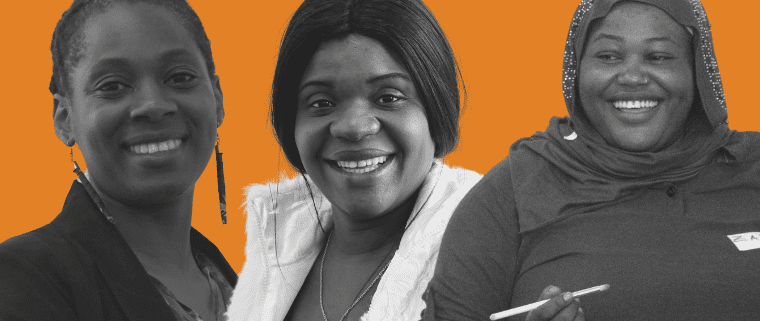
Two women from the Democratic Republic of Congo and Angola describe women’s rights and realities in their home country compared with their experiences in South Africa.
