
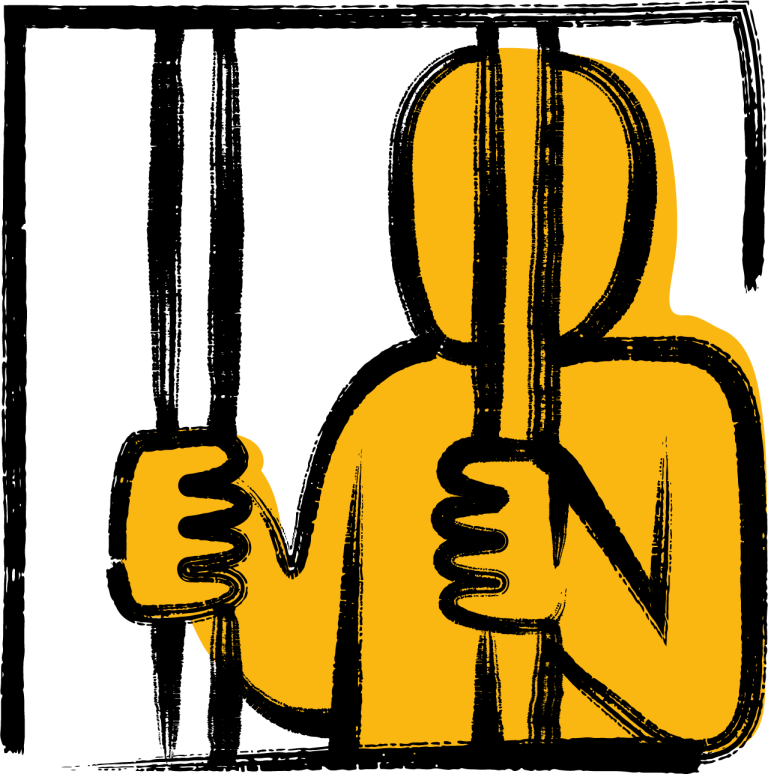
Detention + Deportation
Questions on this page
 Questions on this page
Click on a question below to navigate to it:
This page is for people who are undocumented or do not have legal status in South Africa and are at risk of being detained. It is also for people who know someone who is at risk of being detained because of their documentation status.
You can only be detained for identification and deportation under immigration law, or if you are suspected of committing a criminal offence, including offences under the Immigration Act. You can read more about criminal vs administrative detention here.
In South Africa, only police officers and immigration officers are allowed to ask you to show identity documentation. This was confirmed in a court order. This must be proof of identity, which includes your name and photograph.
You can only be detained if a police officer or immigration officer believes on ‘reasonable grounds’ that you do not have legal stay in South Africa.

Important
Remember, always carry a copy of your documents with you and store your original documents in a safe place, along with your permit number.
1. What are my rights in detention?
It is important to remember that, in South Africa, everyone has rights during detention. It does not matter where you are from, or whether you have documents or no documents – you have these rights. During detention, you have the right:
- To appear in court within 48 hours
- To know the reason why you are being detained
- To make a phone call. If you are detained, you can ask to use the phone at the police station
- To a lawyer (or legal aid, a legal assistance organisation or Law Clinic, if you cannot afford a lawyer), and to an interpreter in court.
- To be treated with dignity (including proper accommodation, food and medical care).
- To be informed of your rights and provided information in a language you understand.
- To have visits from your family / religious counsellors / doctors
- To be kept separate from criminal suspects if held in immigration detention for deportation.
Important
The deportation process could take up to 120 days, starting from the moment you are arrested. If you are not deported after a total of 120 days in detention, you have the right to be released.
If your rights are not being respected, seek legal help. You can find more information at the bottom of this page.
2. Can children be arrested or detained for deportation?
Children should never be detained for deportation and detention is only a ‘measure of last resort’, subject to certain safeguards:
- Detention must be for the shortest time possible.
- Children must not be separated from their parents or caregivers.
- Children must be kept separate from adults
- Children must be held in safe places suitable for their age
Important
Children who are unaccompanied or separated should not be held in detention. They also cannot be deported. They may only be returned to their home country if a social worker and the Children’s Court approve it.
3. What is the deportation process?
If you are found to be in the country ‘illegally,’ you will then be held in a police station. Generally, you will wait until you are transported to Lindela Repatriation Centre, near Johannesburg. Sometimes you are deported from a police station without going to Lindela, but this is usually only if you are being returned to a neighbouring or nearby country.
Home Affairs will arrange your return. You have the right to know what is happening; when and how you will be deported.
You may be deported by bus or plane. Remember, if your detention goes over 120 days, you have the right to be released.
After deportation, you might be declared ‘undesirable’ (banned from re-entering South Africa) for up to five years, and this could affect your future visa applications, even after your ban is lifted.
4. Can I arrange my own return to my country of origin?
Sometimes, with the permission of the Department of Home Affairs, you can arrange to return to your country of origin on your own, provided that you:
- Show a valid travel document
- Buy a plane ticket (usually for a direct flight) to your country of origin
Make sure that immigration has authorised you to arrange the return before purchasing a ticket. If authorised, you will stay in detention until your flight date and be escorted to the airport by immigration. Your family or friends should make sure that your belongings are at the airport for you to take on the flight. Only do this if it is safe to go back to your country.
Important
People who are asylum seekers (whether documented or not) and refugees cannot be deported and are protected by the principle of non-refoulement. You cannot be sent back to a country where your life, freedom, or rights would be at risk.
5. I want more information or support. Who can I contact?
 5. I want more information or support. Who can I contact?
The following organisations can support you with more information and legal advice:
National Immigration Detention Hotline:
WhatsApp: 081 716 8791
Toll free: 0800 079 614
Scalabrini Centre of Cape Town
WhatsApp: 078 260 3536
Lawyers for Human Rights (Durban):
Call: 031 301 0531
Nelson Mandela University Refugee Rights Centre (Gqeberha):
Call: 041 504 1310 or 041 504 4705
Email: refugeerightscentre@mandela.ac.za
University of Cape Town Refugee Rights Clinic (Cape Town)
WhatsApp: 078 594 5591
Call: 021 650 5581
Legal Resources Centre:
WhatsApp: 066 173 3258
Call: 021 879 2398
The contact details above may change. If you cannot get in contact by phone, please visit the webpages for more information.
Related guides
This webpage helps people understand the asylum and immigration system in South Africa. Please note that this is a guide only – it is not legal advice. This information might change. Please call The Scalabrini Centre of Cape Town for any more information. The Scalabrini Centre of Cape Town will not be held liable for action taken with regards to the information on this webpage.
